
The Shortcut
Other paths, other worlds...

Happy Friday, folks, and welcome to the end of January.
Winter finally showed up this month, so I’ve been stuck indoors more than I like. I’ve only braved the cold once or twice for short walks around the neighborhood, which got me thinking about strolls, and detours, and shortcuts, which eventually led to this story.
It probably works as a metaphor for something, but I generally hate pure allegory, so don’t feel pressured to look for deeper meaning anywhere. Much better to take the paths as the come, to meander as you see fit.
Enjoy!
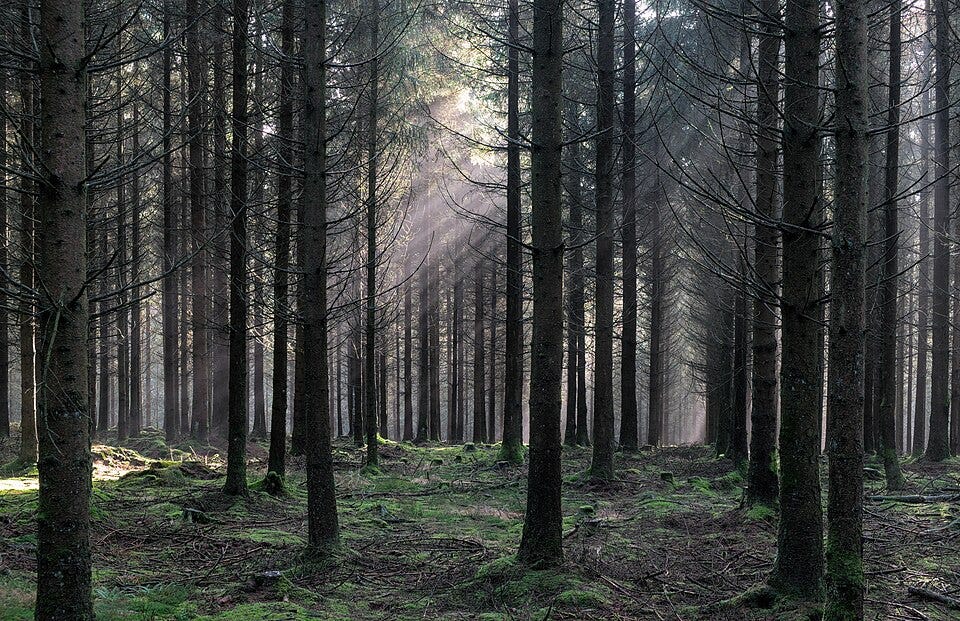
.jpg)
The Shortcut
The first time Jake took the Shortcut, he went missing for seven hours.
It happened on a Wednesday afternoon. His school bus normally stopped at the Elm Street intersection, right across from Mr. Nelson’s house, but with so much ice on the roads it had to let the kids off at the bottom of the hill by the playground. From there, Jake would normally cut across the field to Pine Street and hop the fence into his backyard, but for some reason he felt like taking the long way around: Oak, to Chestnut, to Aspen, and so on.
The running joke was that the streets in his neighborhood were named after the trees the developers had cleared, but Jake’s 7th grade biology teacher had taught them better. Aspens didn’t grow at this elevation, for one thing, and the American chestnut was critically endangered. Even if it grew here, you couldn’t get a permit to chop one down, let alone a whole row of them.
But as he walked, Jake imagined what it would be like to visit that other world, to take shelter from the freezing wind beneath those impossible trees.
He stepped forward. Instead of asphalt, his tennis shoe sunk into soft, forgiving earth, a crisp layer of dried leaves over the loamy soil of the forest. He looked around. Trees stood where houses should have been, brilliant with lichen. Ferns and shrubs crowded the forest floor. The air, which should have been brittle with cold, carried the sweet, damp scent of rot.
If this had happened to him at any other age, Jake might not have made it home. Any younger and he’d have been lost to the enchantment of the place; any older and he’d have despaired at the impossibility of it. Fortunately for Jake, twelve years old is the correct, agreed-upon age to find yourself suddenly transported into another world.
Even so, it took him hours to find his way out. The officer who came by to take his statement asked—very gently—where he had gone after school. Jake didn’t have a name for the place, didn’t know it as the Shortcut yet, so he just said he got lost in the woods.
The adults in the room traded looks. His mother started to cry. His father held her, face grim. The police officer wrote down Jake’s answer without believing it. There weren’t any woods for fifty miles in any direction.
***
Jake kept on using the Shortcut through the rest of middle school and into high school. He wrote down the rules as he learned them and kept them in a notebook beneath his bed so he wouldn’t forget.
The first thing he learned was how to cross from one world to the other. The trick was to treat the place you were standing as the real world and imagine the other place as a kind of daydream. On Elm Street, that meant thinking about elm trees. In the Shortcut, it meant convincing yourself that the forest was real, that the little neighborhood of khaki houses and green lawns and gleaming cars was a funny joke. In order to cross, you had to admit that the other world was impossible and then step into it anyway.
He also learned to bring food and water with him when he used the Shortcut. There were no grocery stores or vending machines, obviously, but there were also no fruit trees, no berries, no mushrooms. If you wanted something to eat, you had to bring it with you.
Finally, he learned that you could only use the Shortcut if you were on your way somewhere. You couldn’t just sit in the park and think yourself to the other side, and you certainly couldn’t stay forever. The other place didn’t offer sanctuary—only safe passage. A detour. A shortcut.
***
Halfway through 10th grade, Jake did something stupid and fell in love with a girl who was already in love with somebody else. He knew this to be a mistake but couldn’t help himself. Aside from the usual excuses of adolescent hormones and youthful optimism, he’d spent years believing in the impossible and didn’t want to admit that love might work any differently.
So he wrote the girl a letter.
Two weeks later, Jake found himself on the losing end of a fistfight. The girl’s boyfriend—11th grade, Junior Varsity and built like it—hammered him with jabs until Jake fell to the ground. More embarrassed than hurt, but still plenty hurt.
The older boy looked down at him, adrenaline already ebbing into guilt. He bent to help Jake off the ground, but Jake pushed his hands away, already turning, reflexively, toward the other place.
Jake staggered up off the forest floor, brushed his hands against his jeans. Two steps away, the other boy stood with his mouth open.
“Where are we?” the boy asked.
If he’d been afraid, Jake might have taken pity on him, but he couldn’t forgive the sense of wonder in the older boy’s voice. This was his place, his alone. Bad enough to suffer the first injury without this added insult. He felt a sudden, overwhelming desire to make the other boy suffer, to punish him for this second, unforgivable sin.
And then, almost immediately, realized how he could do it.
“See for yourself,” Jake said. Then he stepped backward, out of the Shortcut and into the hallway.
Alone.
***
Police came by the school the next day. Posters went up around the neighborhood. There was a story in the newspaper, a special report on TV, a candlelight vigil.
All the while, Jake tried to find his way back into the Shortcut. He packed food, water, first aid kits, flashlights, everything he would need for a proper search. But the gate wouldn’t open for him. He couldn’t reach the mental state that undid the lock, couldn’t convince himself the Shortcut wasn’t real when a real person was starving to death somewhere inside.
More than this, he felt trapped. He recognized the days before the fight as a long, continuous journey from childhood to adulthood, a road with crossings and waypoints and occasional shortcuts. Choosing to kill someone had frozen him in one place, no longer on the way to anything. He was too old for his age now; he was as old as he would ever be.
***
Time passed. People grieved, accepted, forgot. Jake went to college out of state, got married, found work, had kids. He found ways to live with the guilt, to build layers of himself around it until no one could see through to the center.
When his daughter was old enough to go to school, Jake found a remote job that let him work irregular hours so long as they added up to forty every week. He spent his lunch break in the pickup line at the elementary school. He tapped his thumb against the steering wheel, changed the radio station without ever listening to the music, rolled the windows down to catch the fresh air, rolled them back up to block out the fumes.
He hated the feeling of being stuck between the cars, unable to move. Couldn’t bear the thought of his kids walking home from school.
you could really expand this, i’d love to read more!
That was OUTSTANDING!! Thank you!