

In 2021, I did one of the scariest things I’ve ever done as a writer. I closed the tab that held my first draft of Company of Ghosts and never looked at it again.
It’s fair to say that I loathed the first draft. I’d gone so far off the outline by the end of it that I didn’t even know what I was writing anymore. The characters were flat, the writing was atrocious, and the plot was completely unsalvageable. I knew I still had a story worth telling, but the baby-to-bathwater ratio in the first draft was virtually all denominator.
So I threw it out.
When I tell most people this, they tend to fixate on the act of destruction (“You just deleted everything and started over?”). For me, it was much closer to an act of faith. I trusted myself to rediscover those plot points that were inevitable, rather than merely convenient. If I forgot characters or scenes from the first draft, fine. They were, by definition, not memorable—and therefore not worth including.
I’ll admit that this is a pretty extreme way to approach rewrites, but fortune favored my boldness with a workable second draft, and it eventually grew into a novel that I’m fiercely proud to have written.
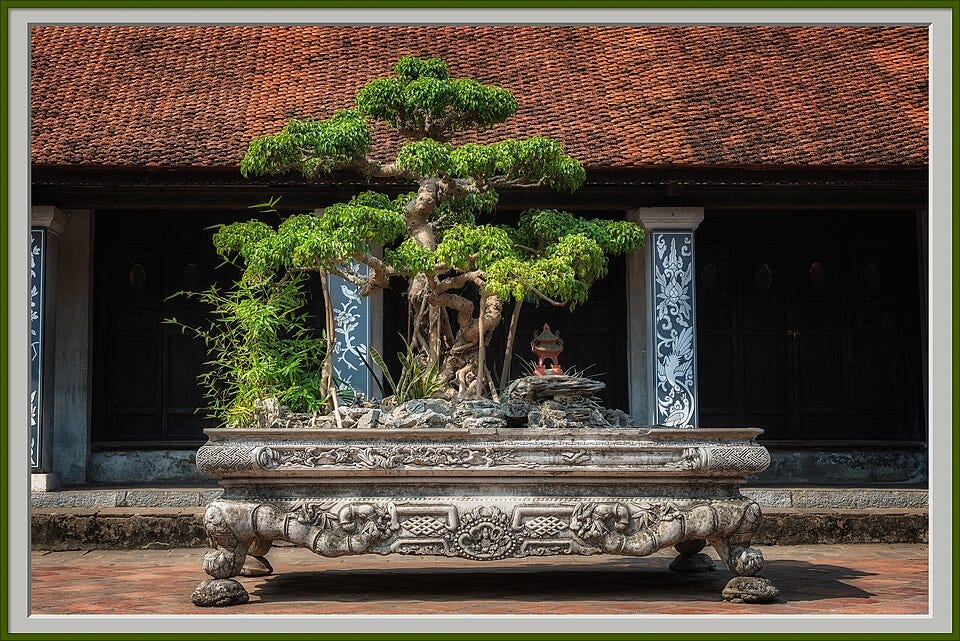
The Art of Bonsai
The reason I’m bringing up second drafts is because I just started another one (God help me). I finished the first draft of The Hope and the Ruin near the beginning of December, and I reread it for the first time last week. There are, of course, lots of changes to be made, but I’m mostly pleased with how it turned out.
At this stage, I’m not really shooting for a final version. My main focus is to discover the central theme of the book and rework the major plot points with that in mind. My go-to analogy for this process is the bonsai tree:
Beginning with the central trunk (theme), I work my way outward to the major branches (character arcs), encouraging growth where the branches are already growing in the correct direction, or else pruning those branches that weigh the tree down without adding to its beauty—all while remaining within the confines of my target word count.
As an example, my intended theme for Company of Ghosts was something like this:
“Find a way to reconcile your past, or else be haunted by it.”
The three main characters (Jalina, Andza, and Rahad) must have an answer to this by the end of the book, and their answers should reflect what they learned on their respective journeys. If a character arc didn’t serve this central theme, it changed. (In Jalina and Andza’s cases, I got pretty close to this in the early attempts, but Rahad needed more work.)
Secondary characters also had to serve the theme to a lesser extent. Ferrec, Jurald, Kyrede, Sethric, and Reia all had their own answers to this question, and each person that Jalina encountered shaped her own answer in some way.
Finally, the tertiary elements of the story (what many people refer to as the genre tropes) had to justify their place on the page. Magic Is Evil served this theme, so it became a crucial part of the setting. Only the Chosen May Wield might be a fun fantasy trope, but it didn’t serve this particular story, so it got the axe.
Now that I’ve read The Hope and the Ruin with fresh eyes, I have a good idea of what the theme of book two will be. Three of the primary characters are close and only need a few changes here and there. The fourth primary character is a problem child at the moment, but I have a few ideas about how to get her back on track.
Book Club… Blues?
Sunday was another milestone for me because someone in my book club suggested reading my book for February and the rest of the group agreed.
I usually show up to book club with the same energy that wrestling fans bring to Monday Night Raw. I’m there to see a fight, and if I can hand someone a steel chair, all the better.
To that end, I made it very clear at the beginning of the meeting that I wasn’t going to take offense at any criticism, and I definitely wasn’t going to settle any arguments (because we all know that the best moments happen when the ref isn’t looking).
It actually went pretty well! People called out things they didn’t like or didn’t understand, and someone else usually rushed to the book’s defense. I don’t think I spoke at all for the first hour and a half. Several people came prepared with notes, and it was a surreal pleasure to hear someone bring up an exact quote or flip to page 237 to settle an argument.
But my favorite moment of the meeting happened at the very beginning, where I thanked my friends for reading my book. I pointed out that in the grand scale of favors, reading your friend’s book cost more time and money than driving your friend to the airport.
“Yeah, but it’s also more fun than driving your friend to the airport.”
— my friend Jimmy
I wonder if he’ll give me a blurb for book two.