

Morning, folks! Here’s a story to start your week.
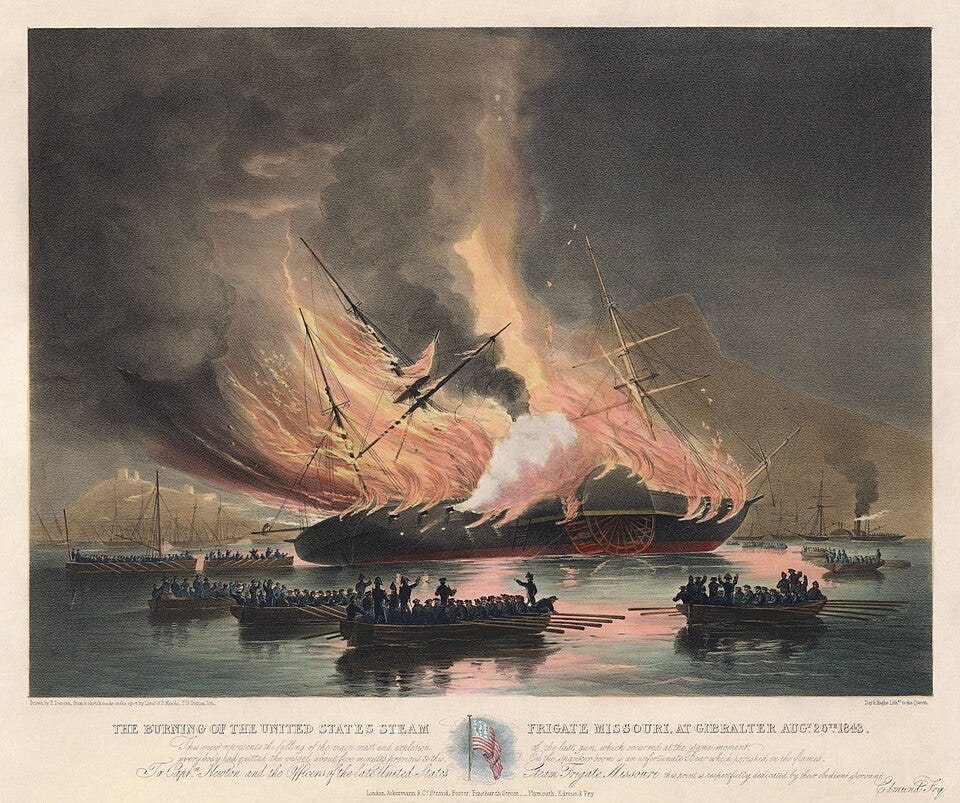
Two Views of the USS Missouri, August 26, 1843
I
The crew watched from the rescue boats, all hands safe but one. They had done their best to scuttle it, this limping, burning beast, bones cracking in the heat, belly full of turpentine and black powder.
Was this love or merely duty: to kill a thing the right way, to drown it before it burned?
II
The bear forgot her name in the heat, became a bear again in truth. She couldn’t understand why the men ran to the low ground to escape the flames—couldn’t be persuaded to understand.
What else did she forget as the guns rumbled beneath her? What, if anything, did she remember?
Under the Influence
The following section is a new feature of the blog where I talk about the inspiration for the story and decisions I made to shape it one way or another. Since I’m still figuring out what this will look like, the first few will be free to all readers. They will eventually go behind a paywall, though, so if you find this kind of thing interesting, please consider becoming a paid subscriber. (The stories themselves will still be available to all readers).
Right, so I sat down to write this story on Sunday afternoon, but I still didn’t have any idea what I was going to write about, so I loaded up the Picture of the Day page on Wikimedia Commons to see if the upcoming pictures sparked any ideas.
Most of the pictures on this page come with a “share alike” license, which means that if you build upon the material, you have to distribute it under the same license. Since I’ve already chosen the license that I want to distribute my stories under (CC BY 4.0), I tend to ignore the images with the SA tag.
Scrolling down the page, I came across this public domain lithograph of the accidental burning of the USS Missouri. I’ve been doing a lot of ship research for book two of my fantasy series, so whenever I see a ship, I tend to quickly label the parts of the ship that I recognize. I’m still not very good at it, but I’m pretty confident that most ships don’t put a live bear on any of the booms.
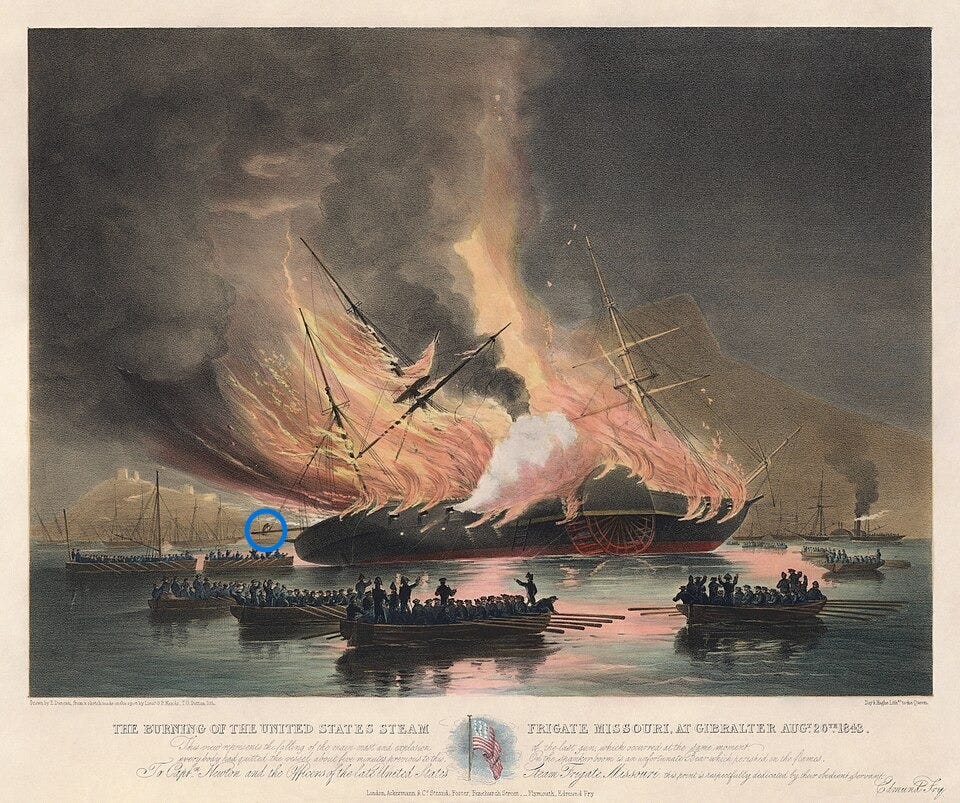
Obviously I had to figure out what this was all about, so I opened a bunch of tabs to read about the disaster.
The fire started when a glass demijohn of turpentine broke in the starboard engineer’s storeroom and leaked through the cracked floorboards onto a lit lantern in the engine room below (moment of silence for our brave ORM instructors). The fire spread quickly through the wooden ship, aided in no small part by the general clutter of flammables in the engineer’s storeroom and the fine layer of coal dust that had settled over everything while under sail.
At this point, the officers had three problems to solve. The first was to save the ship, if at all possible (it was not). The second was to tow it out to deeper water so that the wreckage wouldn’t block the normal functions of the port or pose a hazard to other ships (also impossible). Failing those two objectives, they decided to flood any holds that contained coal, powder, or other combustibles. To sink the ship before it exploded.
From this, I knew what the first and last lines of the story had to be. It would start with the crew watching from the rescue boats, and it would end with “to kill a thing the right way, to drown it before it burned.” I thought it captured the sentiment of the crew, and I liked what it said about human nature. When saving a thing becomes impossible, choosing a proper end for it is an act of love. Sometimes, it’s the only act of love we can manage.
But what about the bear?
The Navy has a long tradition of ship mascots, and the USS Missouri’s mascot had originally done a stint on the USS Ontario before receiving its transfer papers. She often came ashore with the crew, and there was one anecdote about her stealing a bunch of grapes from a fruit vendor while at port and running away with them.
When the fire broke out, the crew did their best to save her, but a bear’s instincts rarely conform to US Navy safety procedures, and convincing a two hundred pound black bear to step into a boat is difficult in the best circumstances (I’ve only managed it two or three times, myself). The bear ended up going down with the ship, the only recorded death associated with the disaster.
From this, I appended the first line of the story with “all hands safe but one.” But that seemed insufficient. I wanted more room to get into the bear’s mind, to try to tie it with the theme of the story as I had written it from the crew’s point of view. I tried it a few different ways, but couldn’t reconcile the two points of view in so short a space, so I split the story into two.
I felt bad for the bear, which is probably why she ended up getting the last line in the story. I like to think that she enjoyed her role as a mascot, that she retained a few good memories from her life at sea, that she at least remembered the taste of grapes.
(Her name was Bess, by the way.)
Wow! If you hadn't explained it, I never would have seen the bear, and the 2nd half of the story would never have made sense to me...